
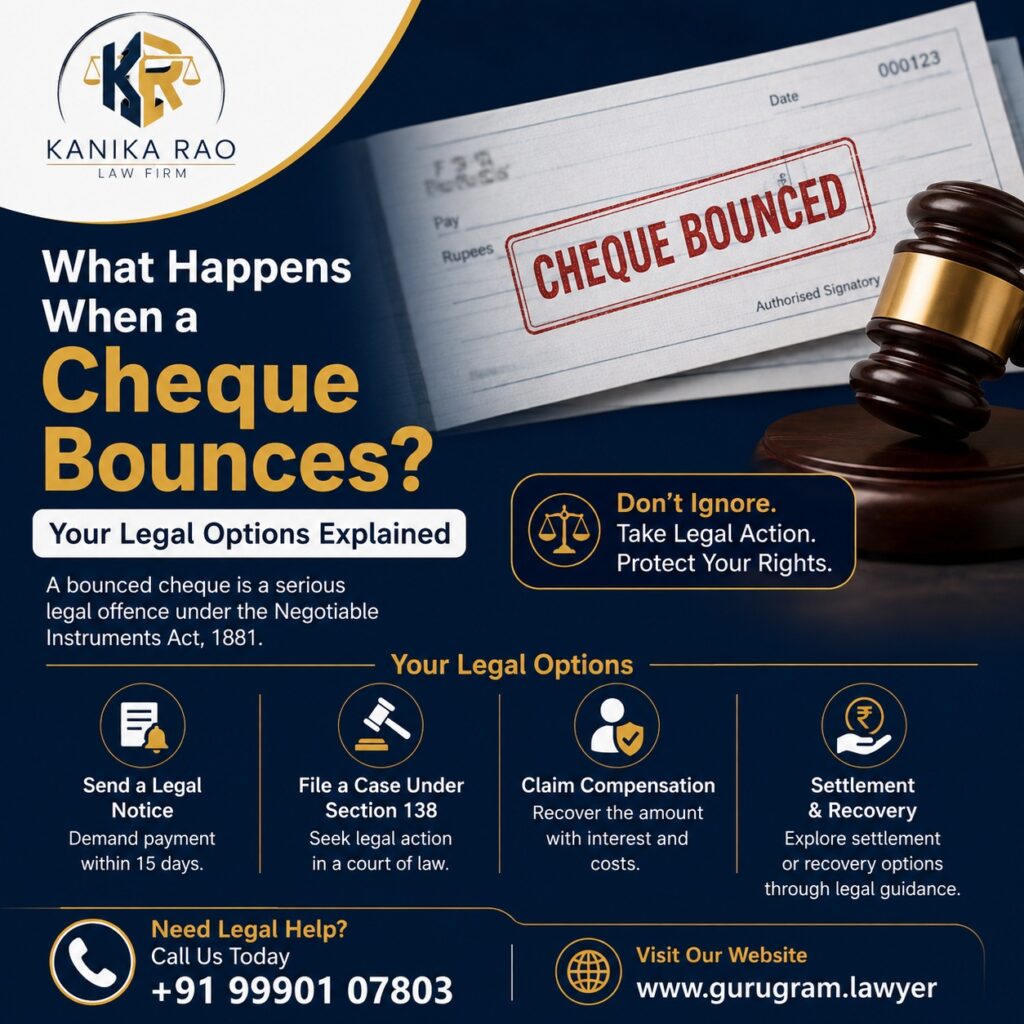
A cheque bounce feels like a small administrative failure until you realise the money is not coming back on its own.
Someone owed you money. They gave you a cheque. You deposited it, and the bank returned it with a memo saying insufficient funds, or account closed, or signature mismatch. Now the person who wrote it is not answering calls.
Cheque dishonour law in India gives you a strong remedy here, but it runs on a strict clock. Miss one of the deadlines and a good case becomes unenforceable, no matter how obviously you are owed the money. So the sequence matters more than almost anything else.
What the law actually says
Section 138 of the Negotiable Instruments Act, 1881 makes it a criminal offence to issue a cheque that is dishonoured for insufficiency of funds or because it exceeds the arrangement with the bank.
Three conditions have to be met for the offence to be made out. The cheque must have been issued to discharge a legally enforceable debt or liability, not as a gift or security in a transaction that has no legal basis. It must be presented within its validity period, which is three months from the date on the cheque. And the drawer must fail to pay after receiving a proper demand notice.
That third condition is where most cases are lost.
A cheque returned for reasons other than insufficient funds can still attract Section 138. Courts have held that “payment stopped by drawer” and “account closed” fall within its scope, because otherwise anyone could defeat the section by instructing the bank to stop payment. A signature mismatch usually falls outside it, though a civil recovery suit remains available.
The timeline that decides your case
This is the part to get right. Write these dates down the day the cheque bounces.
Day 0. The bank returns the cheque and issues a return memo. Keep the original memo and the original cheque. Both are essential evidence and cannot be replaced.
Within 30 days of the return memo. You must send a legal notice for the bounced cheque to the drawer, demanding payment of the cheque amount. Thirty days is measured from the date you receive the information about the dishonour, not from the date on the cheque. This deadline is absolute.
15 days from receipt of the notice. The drawer has fifteen days to make the payment. If they pay, the matter ends there.
30 days after that 15-day period expires. If the drawer has not paid, you must file the complaint before the Judicial Magistrate within the next thirty days. This is a narrow window, and complaints filed outside it are dismissed unless the court condones the delay for sufficient cause.
The whole cycle from bounce to complaint takes about seventy-five days at the outside. Clients who wait a few months before consulting a lawyer often find the window has already closed. If that has happened to you, a civil recovery suit is still available, since the limitation period there is three years, but you lose the pressure that a criminal complaint creates.
What the legal notice must contain
Do not treat this as a formality. The notice is the foundation of the complaint, and defence lawyers attack it first.
It should set out the details of the cheque including number, date, amount, and the bank it was drawn on. It should state the underlying transaction that created the debt. It should record the date of presentation and the date and reason of dishonour. And it must contain a clear, unambiguous demand for payment of the cheque amount within fifteen days.
Send it by registered post with acknowledgement due, and by email if you have an address. Send it to the drawer’s last known address. Courts presume service when a notice is sent by registered post to the correct address, even if it is returned unclaimed, so do not panic if the envelope comes back.
Keep the postal receipt, the tracking record, and the returned envelope if it comes back unopened. Do not open it.
Filing the complaint
The complaint is filed before the Judicial Magistrate First Class. On jurisdiction, Section 142(2) settled a long-running dispute: the case is filed where the branch of the bank in which the payee maintains the account is located. For a Gurugram business banking in Gurugram, that means the Gurugram courts, even if the drawer sits in another state.
The complaint is accompanied by a sworn affidavit, the original cheque, the return memo, a copy of the legal notice, the postal receipt and acknowledgement, and any documents establishing the underlying debt such as an invoice, agreement, or ledger.
The magistrate takes cognizance, records preliminary evidence, and issues summons. The accused appears, is put on notice of the accusation, and the trial proceeds as a summary trial.
One point in your favour: Section 139 creates a presumption that the cheque was issued for a legally enforceable debt. The burden is on the accused to rebut it. That is a meaningful advantage, but it is rebuttable, so keep your documentation of the underlying transaction in order.
Cheque bounce penalty in India
On conviction, the drawer faces imprisonment for up to two years, or a fine which may extend to twice the amount of the cheque, or both. In practice, courts most often impose a fine and direct compensation to the complainant rather than sending first-time offenders to prison.
Two provisions added in 2018 changed the dynamics considerably in the payee’s favour.
Section 143A allows the trial court to direct the drawer to pay interim compensation of up to twenty percent of the cheque amount while the trial is still running. This can be ordered at the stage where the accused pleads not guilty.
Section 148 requires an appellate court, where the drawer appeals a conviction, to direct a deposit of at least twenty percent of the fine or compensation awarded. This removed a common tactic of appealing simply to delay payment.
The offence is compoundable, so the matter can be settled at any stage. A large share of Section 138 cases end in settlement, often at Lok Adalat, and this is usually a better commercial outcome than a conviction that leaves you still trying to recover money.
If you are the one who issued the cheque
Do not ignore the notice. Fifteen days of engagement is far cheaper than three years of criminal trial.
If you have a genuine defence, such as the cheque having been given as security in a transaction that never completed, or the debt having already been paid, or the cheque having been misused after being handed over blank, respond to the notice in writing setting out that position. A reply notice on record is valuable later.
If you simply do not have the funds right now, negotiate. Payment plans agreed in writing and recorded before the court close these matters routinely.
Practical points
File promptly. Delay is the single most common reason otherwise strong cases fail.
Never hand over blank signed cheques. A large share of disputed Section 138 cases involve cheques given as security and later filled in for a different amount.
And keep your paperwork. A cheque bounce case is won on the return memo, the notice, and the postal receipt far more often than on argument.
Holding a bounced cheque?
The thirty-day notice window is the difference between a strong case and no case at all. Our cheque bounce cases lawyers in Gurugram handle Section 138 complaints, legal notices, and recovery suits for businesses and individuals across Delhi NCR. Book a consultation before your deadline passes.
